What issue did the customer face?
A manufacturer of container glass production equipment had to modernize its automation technology due to discontinued CAN components and is therefore planning to switch to an ASi-based safety concept.
The core problem here is that the existing control architecture is based entirely on a specially developed, proprietary CAN protocol. This communication is deeply embedded in the existing software logic and cannot be replaced without significant system intervention. The central control unit communicates exclusively via CAN and does not offer the option of directly connecting modern fieldbus systems such as EtherCAT® or PROFINET®.
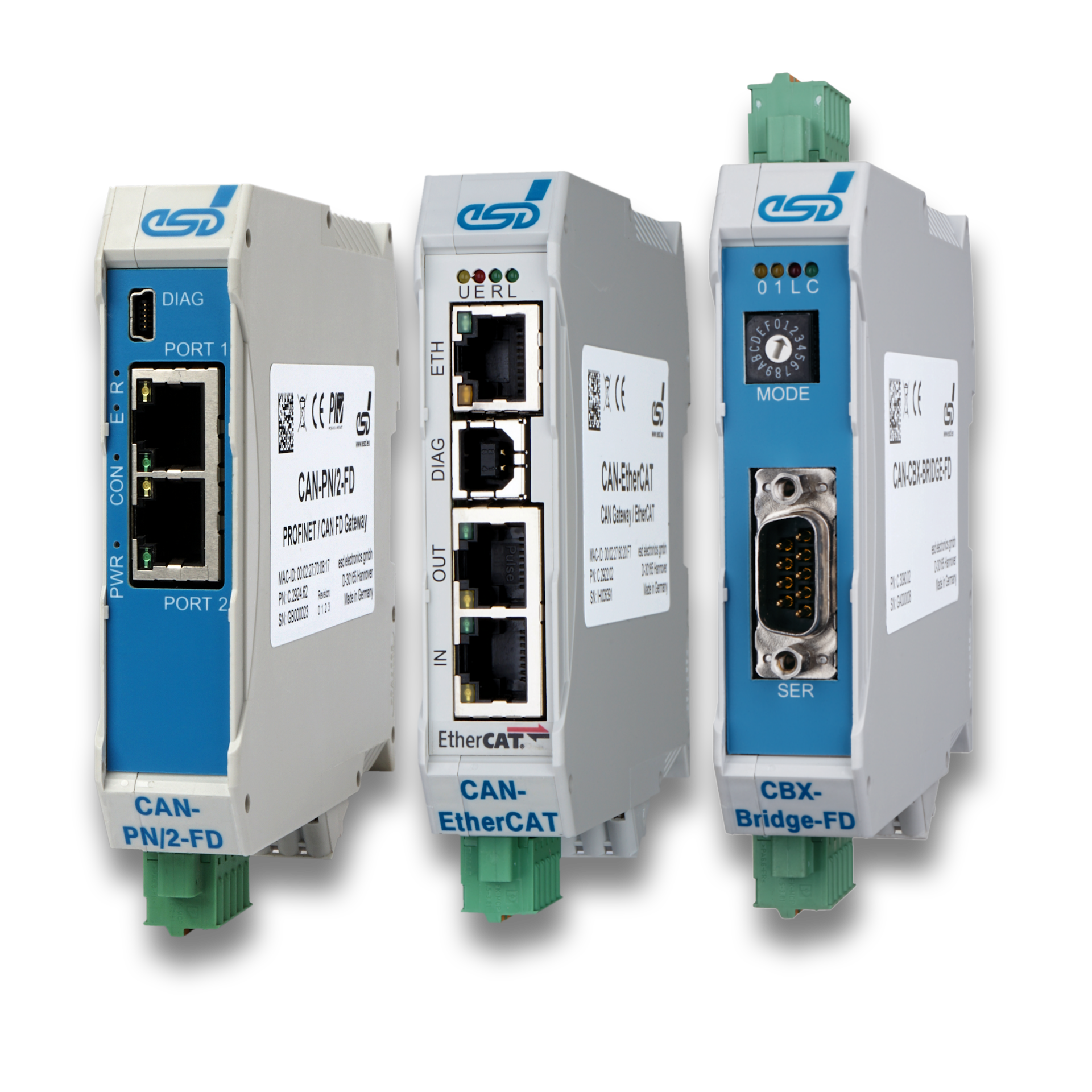
In addition, the new safety concept only provides the EtherCAT interface in the form of an EtherCAT subdevice. This requires a corresponding EtherCAT main device in the system to act as a higher-level control unit. Passive gateways – such as the CAN-EtherCAT/2 – are not suitable for this application because they themselves only act as subdevices and therefore cannot establish communication with other subdevices.
What does the solution look like?
The solution is a customized CAN to EtherCAT gateway that acts as an active EtherCAT main device. It enables a bidirectional connection between the existing proprietary CAN-based control system and the new EtherCAT®-based safety control system. The gateway was implemented by esd electronics based on the powerful and modular esd Embedded Platform. The standard product CAN-CBX-CPU/A9 is used as hardware, which provides the necessary physical interfaces with a CAN CC interface up to 1 Mbit/s and two Ethernet ports.
Software Architecture
Only coordinated, industry-standard components are used: a Linux operating system, the esd CAN device driver with NTCAN API, and the fully integrated, real-time esd EtherCAT MainDevice stack.
A specific software component was developed to enable data exchange, facilitating communication between EtherCAT and the customer's non-standard CAN protocol. To this end, the telegram structure and bus behavior were analyzed in close cooperation with the customer and integrated directly into the software. In addition, the gateway specifically emulates the communication behavior of existing system components by providing identical CAN telegram sequences, timing behavior, and response patterns.


How does this solution benefit the customer?
The customer thus receives a reliable connection between a modern EtherCAT®-based safety controller and an existing proprietary CAN system—without any changes to the existing control logic and with complete retention of the existing infrastructure. The gateway developed by esd electronics establishes the functional connection between the two system worlds.
In addition, customers benefit from extended diagnostic functions: The esd CAN device driver provides a remote CAN interface via integrated EtherCAN technology. This can be used with the CANreal tool for detailed analysis of CAN data traffic over IP networks. At the same time, the integrated EtherCAT MainDevice stack offers remote access via the esd EtherCAT Workbench, a powerful tool for online diagnosis and configuration of EtherCAT networks. All tools are natively compatible with the platform used and are ready for immediate use. The solution creates a stable bridge between old and new systems and lays the foundation for a long-term maintainable, diagnosable, and expandable control architecture.